Fact check · Unsubstantiated
Bradford says Toronto trains officers and loses them to better-staffed forces. The service's own budget says they're retiring.
In the video announcing his 1,000-officer pledge, Bradford said Toronto trains officers and then loses them "to forces that aren't running on empty." Toronto Police Service budget documents for two consecutive years attribute rising departures to something else entirely — and mention other police services not once.
A safe city isn't built by asking people to do more with less. My plan will hire 1,000 more police officers to serve our communities and back up existing officers.
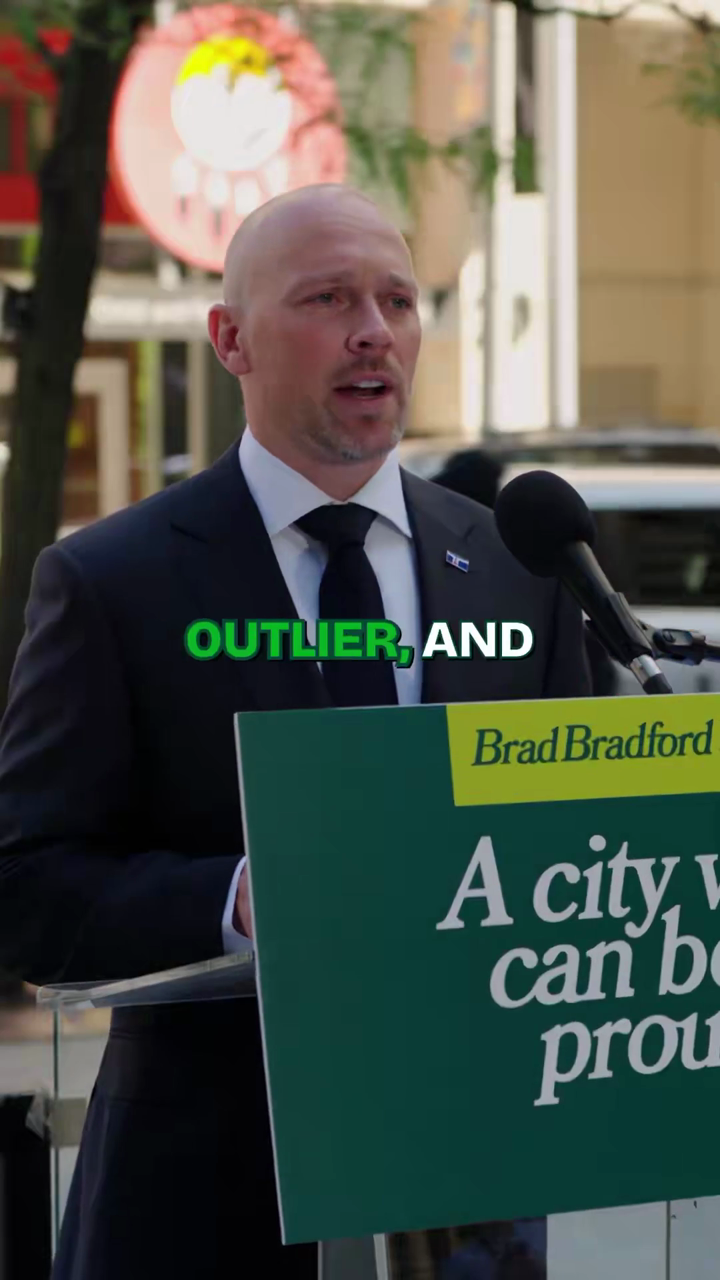
Transcript — from Whisper transcription of the clip's audio, excerpted
[...] A thousand more officers means more backup arrives faster when you call for it. It means shifts that let officers go home to their families. It gives officers time to get to know the neighbourhood [...] walking it on foot instead of racing from call to call in a car. And it means that the best people stay here with the Toronto Police Service[s], because right now we train officers and then we lose them to forces that aren't running on empty.
What he said
The video announcing Bradford’s 1,000-officer pledge closes on retention. After describing double shifts and burnout, he says a larger force would mean “the best people stay here with the Toronto Police Service, because right now we train officers and then we lose them to forces that aren’t running on empty.”
It is a specific causal claim: Toronto pays to train officers, and other, better-staffed services take them. We went looking for the evidence.
What the police service says causes its attrition
Toronto Police Service budget documents address this directly, and the answer is demographic rather than competitive. From the 2025 budget notes:
“The number of officers eligible for retirement is set to rise significantly. Annual separations, which have been around 200, are expected to increase steadily and remain high for several years. This trend stems from hiring freezes in the late 1980s and early 1990s, leading to large cohorts of officers, hired in the mid-1990s, now approaching retirement age in the late 2020s.”
The 2026 notes say the same thing in different words: by 2029, 21% of the total uniform workforce will be eligible to retire, and 84% of uniform senior officers.
That is a bulge working its way through a pension timeline — the predictable echo of a hiring freeze thirty years ago. It is a real staffing problem. It is not the problem Bradford described.
What isn’t in either budget
We searched both years’ budget notes for any reference to officers leaving for other services — “other police service,” “lateral transfer,” “competing,” “poaching,” neighbouring regions. Neither document mentions any of it, once.
The closest either comes is a single line in the risk register, identical in both years: “Labour conditions need to be competitive to attract and retain members.” That is a generic statement about pay and conditions. It is not a finding that Toronto is losing trained officers to rivals, and it is the only thread in either document that runs in that direction.
The numbers run against the claim
| Historical annual separations | ~200 |
| Projected separations, 2025 | 210 |
| Projected separations, 2026 | 217 |
| 2025 actual | Below forecast — the 2026 budget funds 29 extra hires “due to fewer separations” |
Separations are rising, on the curve TPS forecast years ago. But 2025 came in under projection, which is the opposite of an accelerating exodus.
The composition of the force cuts the same way. Nearly 25% of uniform members have under five years of service, and 37% have under ten. Bradford’s phrasing — “we train officers and then we lose them” — describes newly trained officers walking out. The service is full of newly trained officers. The people leaving are the ones who arrived in the mid-1990s.
Where he is right
Two parts of the surrounding argument hold up, and it would be dishonest to check the retention line without saying so.
“It’s more calls” is true, and confirmed by the service. The 2026 budget’s risk register states plainly: “Call volume and caseload are increasing faster than resourcing.”
Recruitment across the region genuinely is harder than it was, and Toronto competes for candidates with every other force in the GTA. A claim that recruiting is difficult would have been on solid ground. The claim he made was narrower and stronger — that trained Toronto officers are being lost to better-staffed services — and that is the part without support.
What would settle it
TPS separates roughly 210 to 217 officers a year. Someone knows how many of those are retirements, how many are resignations, and how many of the resignations went to another police service. That breakdown is not in the public budget documents.
If the campaign has it, publishing it would move this rating immediately. If it doesn’t, the claim was made without it.
The ruling
Attrition is real and rising. The mechanism Bradford asserts for it is not supported by the two most detailed public documents on Toronto Police staffing, which attribute the same trend to a retirement cohort and never once mention losing officers to other forces.
We are not saying no Toronto officer has ever left for another service; some certainly have, and no published data lets anyone rule it out. That is the point. A claim stated this confidently, as the closing argument for a $143-million-a-year commitment, should rest on something a voter can check. This one rests on nothing published.
Unsubstantiated.
Sources
- Post by @BradMBradford, 23 July 2026 (96-second announcement video)
- BudgetTO 2026 Budget Notes — Toronto Police Service
- BudgetTO 2025 Budget Notes — Toronto Police Service
- Brad Bradford vows to hire 1,000 police officers over 4 years if elected
- Toronto mayoral hopeful pitches hiring 1,000 new police officers
- Are Toronto-area police forces finding it harder to recruit after years of turbulence?
- Toronto Police Service's Multi-Year Hiring Plan and the Costly Budget Implications